
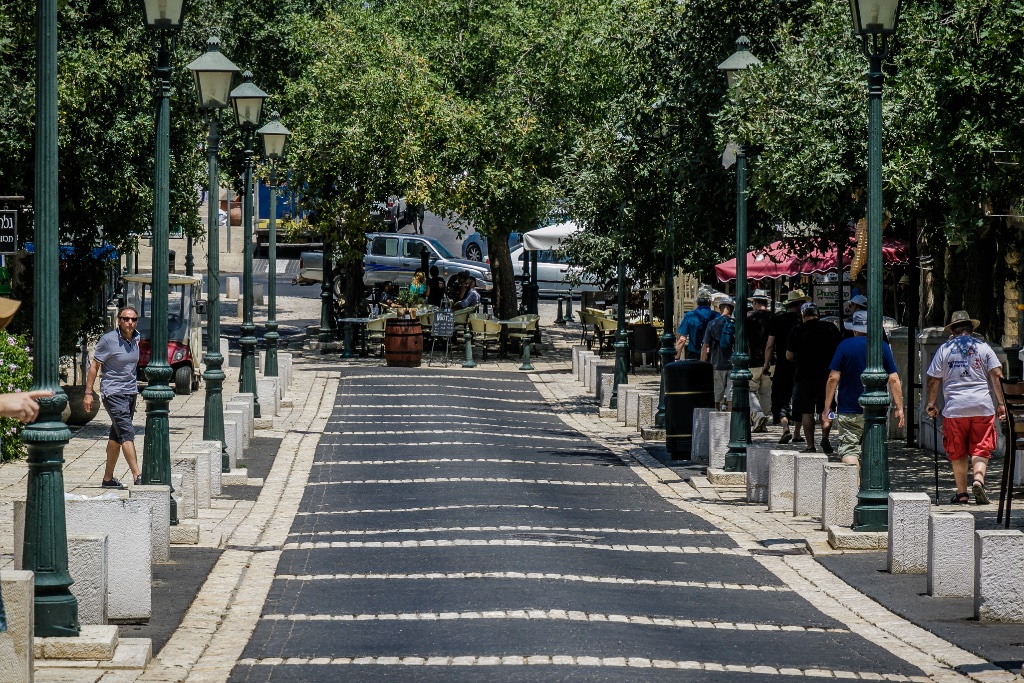
The historic town center is one of the areas most closely associated with Zichron Yaakov. This is an environment where residences, commerce, tourism, buildings designated for preservation, and local history coexist. Consequently, purchasing property in this area requires a different perspective than that applied to a new residential neighborhood.
Zichron Yaakov was founded in December 1882. In 1883, Baron Edmond de Rothschild began supporting the settlers, and during this period, the old center was planned in a style that influenced the main street and the town structures. The Local Council describes the Wine Route as a restoration and preservation project of HaMiyasdim Street, the main street of the town, and characterizes the area as a hub for many of Zichron Yaakov's historic sites.
What is the Town Center?
There is no single real estate boundary that strictly defines the town center. In the local context, it usually refers to the historic center and the surrounding streets, centered around HaMiyasdim Street/the Wine Route, HaNadiv Street, and the established urban fabric.
Before attributing the advantages of the town center to a property, buyers should check:
- The exact address
- The actual distance from the pedestrian mall axis
- The level of traffic and commercial activity in the vicinity
- Available parking
- Preservation restrictions, if any apply
- Permitted uses for the property and adjacent properties
Two houses located a short distance from each other can offer very different living experiences.
The Wine Route and the Preservation Fabric
The Local Council describes the Wine Route as a restoration and preservation project of HaMiyasdim Street. According to the official timeline, the project began in 1992 and was completed in 1996. As part of the restoration, features characteristic of the historic built environment were maintained or restored, including facades, wooden windows, tiled roofs, stone and wood fences, and elements of traditional farm courtyards.
For a buyer of a property within the historic fabric, preservation is not merely an aesthetic matter. It may affect:
- Renovation possibilities
- Changes to facades
- Openings and windows
- Roofs
- Building additions
- Integration of new systems
- Commercial uses
- The permitting process
Therefore, buyers should check if the property, the structure, or the site is subject to preservation guidelines and what the practical implications of those requirements are.
Property Types in the Town Center
The historic center is not a uniform complex. It contains properties from various periods with different characteristics, such as:
- Historic houses
- Detached homes
- Properties that have undergone renovation and preservation
- Apartments in small buildings
- Properties with interior courtyards
- Properties with mixed uses
- Commercial properties or those with commercial potential, subject to planning and permits
Given this variety, price comparisons must be very precise. A property designated for preservation is not necessarily comparable to a new house, and a property on a commercial axis is not necessarily comparable to a house on a quiet side street.
Parking, Traffic, and Noise
One of the most important issues in the town center is balancing proximity to street life with the quality of residential life.
It is recommended to visit the property:
- On a weekday morning
- In the afternoon
- In the evening
- On the weekend
- During local events, if applicable
Visiting at these times helps to better understand:
- Pedestrian traffic
- Parking availability
- Noise from businesses
- Traffic on nearby streets
- Privacy
- Waste collection and municipal services
- Seasonal congestion
Proximity to the pedestrian mall can be a significant advantage for those seeking a central lifestyle and high accessibility, but it is not equally suitable for every buyer.
Planning and Legal Checks
In the historic center, checking legal documents is just as important as the physical appearance of the house.
Before purchasing, it is recommended to verify:
- Registration of ownership rights.
- The building permit and the approved status.
- Alignment between the permit and the current state of the property.
- Preservation guidelines.
- Additions or enclosures built over the years.
- Permitted uses.
- Remaining building rights.
- Parking and property attachments.
- Easements or shared access.
- Plans applicable to the lot and the surrounding area.
For older structures, it is advisable to add a comprehensive engineering inspection, including the roof, moisture issues, waterproofing, systems, walls, foundations, and components that have been altered over the years.
The Advantage of Walkability and Accessibility: Check, Do Not Assume
The town center is known for its proximity to cafes, restaurants, galleries, shops, services, and heritage sites. This is one of the area's greatest advantages.
However, walkability must be evaluated based on the specific property, considering:
- Slopes and inclines
- Sidewalk conditions
- Road crossings
- Accessibility
- Actual distance
- The specific needs of children or elderly residents
The topography of Zichron Yaakov can turn a short distance on a map into a significantly different route in practice.
Preservation and Future Development
The Council has published preservation guidelines as part of its approach to maintaining the character of Zichron Yaakov while managing development and densification. This means that in the historic center, buyers should also evaluate the potential for future changes to nearby properties and the balance between building rights and the preservation of the historic fabric.
Before buying, it is worth checking approved and deposited plans for the area rather than relying solely on the situation observed during a site visit.
Who is the Town Center Suitable For?
The historic center may be particularly suitable for those who value:
- Local character and heritage
- Proximity to commerce and culture
- The ability to conduct parts of the day on foot
- Properties that are not standard
- Living within a vibrant, non-homogeneous neighborhood
Conversely, those seeking new streets, ample parking, uniform modern planning, or absolute quiet should carefully evaluate the specific location.
Selling a Property in the Town Center
When marketing a property in the historic center, it is important to present its characteristics accurately:
- Whether it is designated for preservation
- Its planning status
- Its true proximity to the pedestrian mall
- Parking availability
- Courtyard features
- Privacy
- Permitted uses
- Physical condition
- Renovation or expansion possibilities
History is an advantage only when backed by facts and documentation. Do not present rights, uses, or future potential without verification.
Summary
The town center is a unique area where the history of Zichron Yaakov meets daily life. The Wine Route, historic buildings, and the old urban fabric create a residential environment without parallel in the newer neighborhoods of the town.
However, precisely because of this uniqueness, every transaction requires individual verification of preservation status, planning, parking, permitted uses, physical condition, and the immediate surroundings.
Main Sources
- Zichron Yaakov Local Council, About and History.
- Zichron Yaakov Local Council, The Wine Route, Restoration and Preservation of the Town Center.
- Zichron Yaakov Local Council, Preservation Guidelines.
- Planning Administration, Planning Information System.